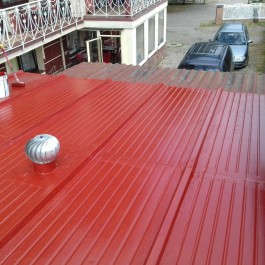
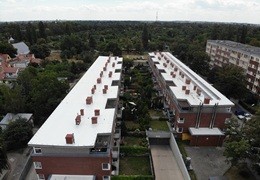
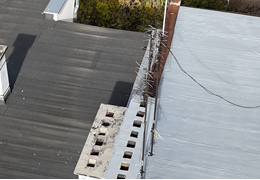
Flat roof waterproofing protects the roof surface from water and moisture infiltration. This is a key element in roof construction and longevity, especially in flat structures, which are more susceptible to water accumulation. Bituminous membranes, such as felt, were once used as the primary roof protection against moisture. However, over the years, these membranes have degraded significantly, and new methods for protecting flat roofs are being sought. These methods include the application of liquid roofing membranes , such as polyurethane coatings , acrylic coatings , or polyurea coatings (often called liquid rubber ).
Why does a flat roof require waterproofing?
Flat roofs, due to their low slope, have limited rainwater drainage capacity. Water often stagnates on their surface, which can lead to:
Moisture penetration into the building,
Formation of molds and fungi,
Structural damage caused by prolonged exposure to moisture.
Additionally, UV rays contribute to the structural damage mentioned above. Choosing the right waterproofing system is therefore crucial to keeping the roof and the entire building in good condition for as long as possible.
What are the consequences of lack of waterproofing?
Lack of proper waterproofing can result in serious problems such as:
Flooding of rooms under the roof,
Decreased durability of building materials,
Increased operating costs related to repairs and renovations.
High temperature in attic rooms.
Types of flat roof waterproofing
Bituminous waterproofing
Bitumen is a traditional waterproofing material that can be used in the form of heat-sealable felt or bituminous masses. It is durable but requires careful application. Over time, it is easily damaged and often cracks, leading to leaks. Bituminous coatings are black, which additionally absorbs heat, heating up and leading to high temperatures in rooms on the top floors of residential buildings. Typically, previously installed felt is protected with polyurethane , acrylic , or polyurea coatings .
Polyurethane coatings
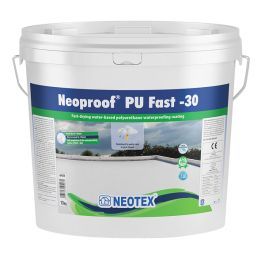
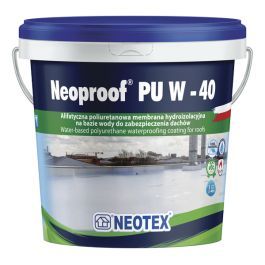
Polyurethane coatings are a modern solution that create a uniform, seamless layer. They are ideal for roofs with irregular shapes. Their single-component construction makes them easy to apply. Simply mix the liquid polyurethane membrane in the package and then apply it with a roller, brush, or spray. Polyurethane membranes such as Neoproof® PU W-40 and Neoproof® PU Fast-30 are water-based, which reduces odor and is also environmentally friendly.
Polyurea coatings
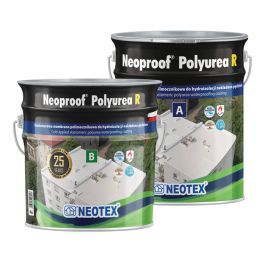
The most durable method of flat roof waterproofing, it demonstrates not only excellent moisture resistance but also enormous material elasticity, up to 400%. This translates into virtually impossible damage to the coating, except through deliberate mechanical damage. Neoproof® Polyurea R , which represents this type of coating, provides flat roof waterproofing for a dozen or even more years. The product's two-component construction translates into durability, as well as mechanical and chemical resistance of the cured coating. The product is also resistant to early rainfall, allowing it to be applied in unpredictable weather conditions without fear of the material running off the roof.
Acrylic coatings
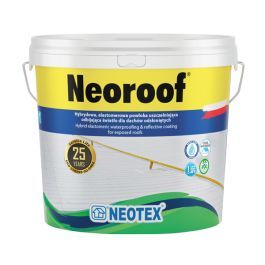
This type of membrane is very similar to polyurethane membranes, as these two groups are chemically very similar. Neoroof, a hybrid acrylic membrane , is an ideal solution for flat roofs protected with PUR foam or sheet metal, among other things. Thanks to the low consumption of these materials, you can protect flat roofs from moisture at a low cost. It's also worth noting that this membrane is UV-cured. Therefore, it is not only resistant to UV rays but also essential for the coating's curing process.
Advantages of flat roof waterproofing
Leak protection : An effective barrier against water and moisture. Seamless construction, along with the ability to reinforce the entire surface or joints with a special reinforcing fabric, such as Neotextile , ensures your roof is protected for at least a decade without the risk of leaks.
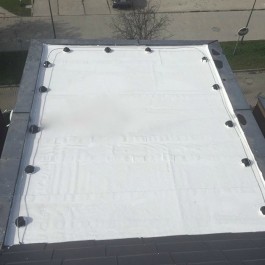
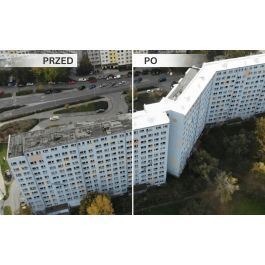
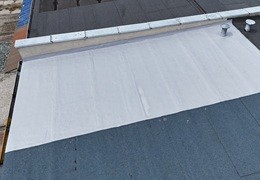
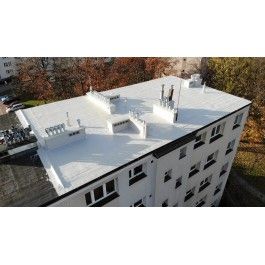
Improving energy efficiency : Proper insulation can reduce heat loss. Using white roofing membranes such as Neoproof® Polyurea R , Neoproof® PU FAST , or Neoproof® PU W -40 allows for the so-called "cool roof" effect. White coatings not only reflect light rays, lowering the roof surface temperature, but also lower the temperature of the rooms directly beneath the roof. This light reflection also increases the efficiency of photovoltaic panels.
Increasing the roof's lifespan : Protects the structure from moisture-related damage. Properly installed waterproofing significantly extends the lifespan of the roof, and the entire building. Therefore, it's worth choosing modern waterproofing methods, which are lightweight and do not burden the building structure. This is a definite advantage over traditional roofing felt.
Reduced maintenance costs : Long-lasting protection reduces the need for frequent repairs. However, if such repairs occur due to mechanical damage or simply the passage of time, they can be easily repaired, even locally, by applying an additional layer of coating.
How to prepare a flat roof for waterproofing?
Assessment of the technical condition of the roof
Before starting work, check the condition of the roof surface, the material with which the roof was previously protected, and identify any damage.
Removal of impurities
The roof surface should be free of dust, debris, and other contaminants to ensure good adhesion of waterproofing materials. Degreasing the surface is also important, as greasy contaminants, such as those from exhaust fumes, settle on the roof and significantly reduce the adhesion of all materials. Sulfanol . It's also worth remembering to treat the roof surface if mold has appeared. Washing alone may not be sufficient because the mycelium is trapped in the pores of roofing felt, for example. The mold will reappear at the next opportunity and under favorable conditions. Therefore, it is recommended to use a special agent that will remove existing and visible mold and protect the roof from future growth.
Repairing damage
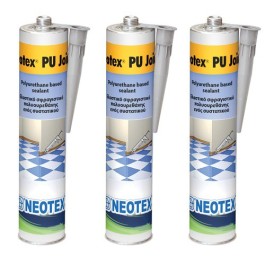
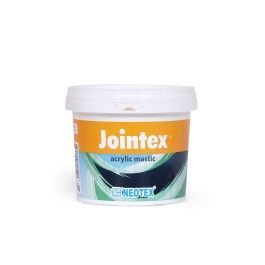
Any cracks, holes, or irregularities must be repaired before applying the waterproofing. If blisters are visible on the felt, moisture is likely trapped beneath them. These should be slit open and the gaps filled with Jointex® for water-based waterproofing membranes or Neotex® PU Joint for solvent-based membranes such as Neoproof® Polyurea R.
Choosing the right materials
The choice of technology and materials depends on the roof type, its intended use, and the investor's budget. The minimum durability of the coating and its subsequent renovation and maintenance should also be considered.
How to waterproof a flat roof?
Preparation of the substrate
The substrate should be dry, clean, and free of loose particles. It should be properly washed, preferably with a pressure washer, and degreased and fungicide-free. This will ensure proper adhesion for the primer.
Application of the primer layer
A primer should be applied to the roof surface to enhance the waterproofing's adhesion. For roofing felt and water-based coatings, the recommended primer is Revinex® , which also works well on concrete substrates. Neoproof® Polyurea R can be applied to roofing felt without any primer, after cleaning and degreasing the existing coating. For substrates such as EPDM or PVC membranes, sheet metal, aluminum, or concrete, it is necessary to select an appropriate primer.
Membrane installation or coating application
Depending on the chosen system, the membrane is applied using a roller, brush, or mechanical spray. Work begins by securing the joints between the old waterproofing membrane, chimney outlets, flashings, and all vertical-to-horizontal joints. Only then is the membrane applied to the entire prepared flat roof surface.
Quality control
After completing the work, a leak test should be carried out, e.g. by flooding the roof with water.
Care and maintenance of flat roof waterproofing
Regular inspections and maintenance will keep your roof in good condition. We recommend:
Periodic cleaning of surfaces,
Checking the condition of membranes or coatings,
Repair minor damage immediately upon detection.
Product offer
Active filters
NOTE: THIS IS A WATER-BASED PRODUCT. Select temperature-controlled shipping to receive your product on the promised date, regardless of weather conditions. Standard shipping may be delayed due to temperatures below 5°C encountered along the delivery route.
NOTE: THIS IS A WATER-BASED PRODUCT. Select temperature-controlled shipping to receive your product on the promised date, regardless of weather conditions. Standard shipping may be delayed due to temperatures below 5°C encountered along the delivery route.
Single-component roof waterproofing for cold application. Recommended for roofs covered with felt , concrete flat roofs, and metal roofs. Resistant to UV and mechanical loads. Creates a smooth, uniform waterproofing layer without joints, resistant to a wide temperature range from -40°C to +80°C . It has solar reflective and "cool roof" properties, confirmed by the Cool Material certificate (white).
Revinex primer should be used on the roofing felt !
NOTE: THIS IS A WATER-BASED PRODUCT. Select temperature-controlled shipping to receive your product on the promised date, regardless of weather conditions. Standard shipping may be delayed due to temperatures below 5°C encountered along the delivery route.
A liquid, UV-cured roof waterproofing membrane. Suitable for all roofing types, including roofing felt . The white coating perfectly reflects solar radiation (up to 88%) and reduces roof temperatures by up to 40% . It provides complete sealing and weather resistance.
Neoroof liquid membrane has a European Technical Assessment (ETA 24/1246) and is classified in the highest durability class W3 (according to EAD 030350-00-0402), which confirms its expected service life of up to 25 yearsin a reinforced system (1.2 mm).
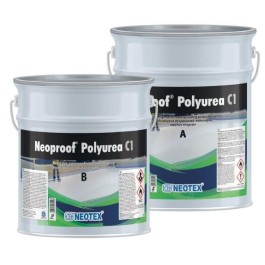
A two-component, cold-applied polyurea waterproofing membrane for roofs, terraces, or balconies. Rainproof within 1 hour of application. It prevents moisture absorption and seals. Resistant to UV radiation and mechanical damage.
Neoproof Polyurea R has a European Technical Assessment (ETA 24/1247) and is classified in the highest durability category W3 according to EAD 030350-00-0402, which confirms an expected service life of up to 25 years.
Neoproof Polyurea R liquid roof membrane is root resistant (according to CEN/TS 14416:2014 ), external fire resistanceEN 13501-5 . Polyurea R is classified as Broof (t1) and has certified "cool roof" properties (Cool Material ).
A filler for joints and gaps. It adheres to the substrate, is weather-resistant, and can be repainted. Recommended for use under flexible roof coatings.
A two-component waterproofing membrane for application to smooth surfaces. Rainproof in just 2 hours after application . Creates a coating resistant to moisture and mechanical damage. Perfect for roofs, balconies, and terraces.
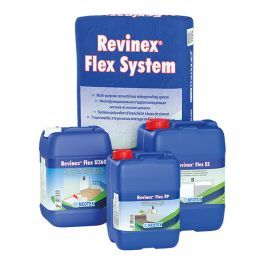
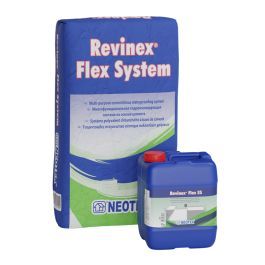
Revinex® Flex System is a multi-purpose cementitious waterproofing system for flat roofs, wet rooms, balconies, and terraces. Its functionality varies depending on the type of component B used, allowing the product to be adapted to various needs. Its functionality varies depending on the type of component B used, allowing the product to be adapted to various needs. It is ideal as a waterproofing layer under tiles and for bridging cracks and fissures in the substrate.
The durability of waterproofing depends on the materials used and operating conditions. In the case of high-quality membranes or coatings, it can last up to 20-30 years.
Does flat roof waterproofing require regular inspections?
keyboard_arrow_downkeyboard_arrow_up
Yes, regular inspections are crucial to maintaining tightness and preventing costly repairs.
What are the costs of flat roof waterproofing?
keyboard_arrow_downkeyboard_arrow_up
Costs depend on the chosen system, roof size, and surface condition. Average costs range from several dozen to over one hundred zlotys per square meter.
Can you do waterproofing yourself?
keyboard_arrow_downkeyboard_arrow_up
You can do waterproofing yourself for smaller roofs and simple systems, but for the best results, it is best to use the services of professionals.





 Anti-corrosion
 Fireproof
 Resin floors
 Roofs
Roofs
 Tanks and pools
 Terraces and balconies
 Hygienic paints
 Facades and interiors
 Accessories
 Call:
Call:

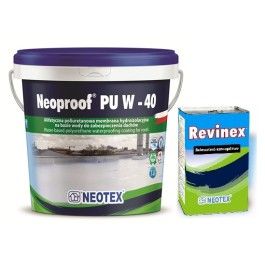
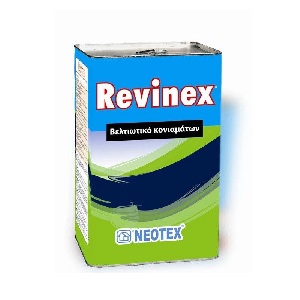 primer should be used on the roofing felt