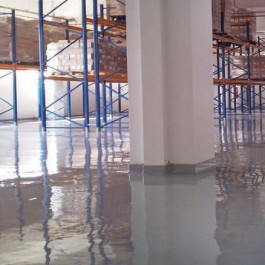
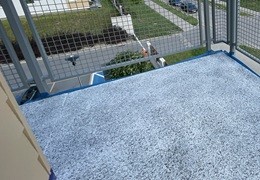
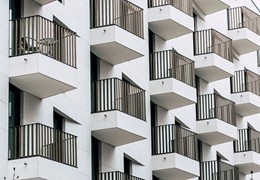
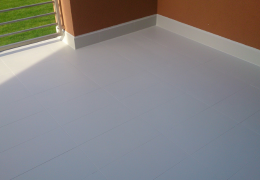
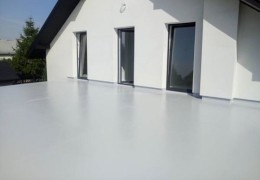
Polyurethane resin is a synthetic polymer characterized by high elasticity and abrasion resistance. It is used as a protective coating on various surfaces, including terraces, where it provides durability and an aesthetic finish.
Features and properties of polyurethane resin
UV Resistance : The polyurethane coating is chalk-resistant, preventing whitening during outdoor use. Furthermore, aliphatic polyurethane does not yellow when exposed to sunlight, ensuring long-lasting aesthetics.
Flexibility : Adapts to the natural movements of the substrate, minimizing the risk of cracking.
Chemical resistance : It is highly resistant to chemicals, which is important in the case of exposure to various substances, such as those contained in acid rain or exhaust fumes.
Polyurethane resin and other types of coatings
Compared to epoxy resins , polyurethane resins offer better flexibility and UV resistance, making them more suitable for outdoor applications such as terraces.
Advantages of using polyurethane resin for a terrace
Durability : High resistance to abrasion and mechanical damage.
Aesthetics : Various finishes are available, from matte to high-gloss, depending on your preference. Selected polyurethane resins can be tinted, allowing for unique and aesthetic designs tailored to the client's vision.
Easy to maintain : Smooth, jointless surface makes cleaning and maintenance easy.
How to prepare a terrace for the application of polyurethane resin?
1. Assess the Substrate Condition
: Ensure the surface is stable, dry, and free of cracks and loose particles. Remove any loose particles to improve adhesion and durability of the entire flooring system.
2. Cleaning
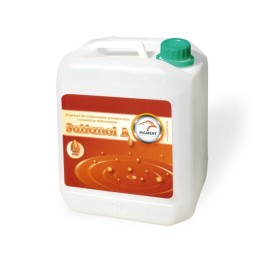
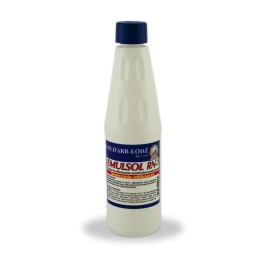
: Remove all dirt, grease, and other contaminants that may affect resin adhesion. It's recommended to use special degreasing agents such as Sulfanol A or Emulsol . However, remember that after using any cleaning or degreasing agents, they must be thoroughly washed off. Unremoved residue will affect the adhesion of the subsequent decking system.
3. Repairing Damage:
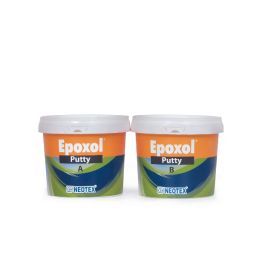
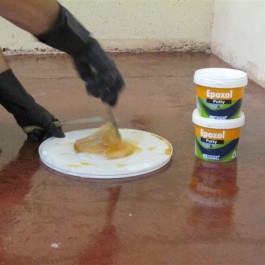
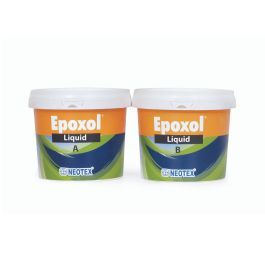
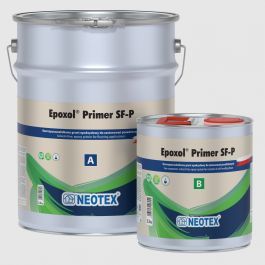
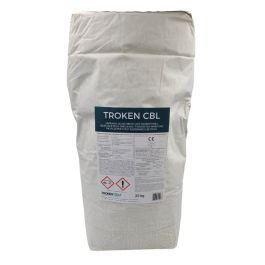
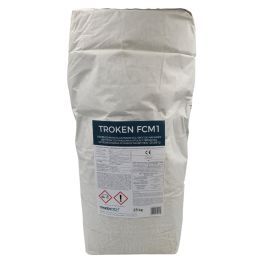
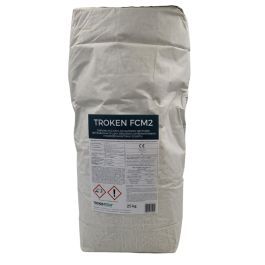
If there are any gaps or cracks, they must be filled. epoxy-based repair compoundsEpoxol® Putty or Epoxol® Liquid . You can also make your own repair compound or use an epoxy screed using Epoxol® Primer SF-P . In the case of large defects, it is worth reprofiling the substrate using PCC compounds such as Troken CBL , Troken FCM1 , or Troken FCM2 . The final surface should be as smooth and uniform as possible before applying resin systems .
4. Sanding
: Sanding the substrate is always recommended to increase the resin's adhesion to the substrate. Depending on the type of system being applied, different sanding methods are recommended. For thin-layer systems applied with a roller, the substrate should be gently sanded to open the pores and increase adhesion. On the CSP scale, this is a 2 or 3. However, if thick-layer or self-leveling systems exceeding 1 millimeter in thickness are being applied, shot blasting or milling is recommended. On the CSP scale, this is a 4 or 5. This substrate preparation should ensure adequate adhesion and, therefore, the system's durability for years.
5. Priming:
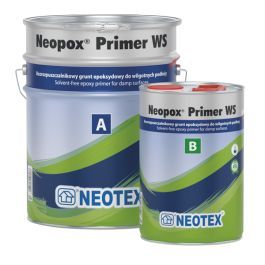
When applying polyurethane resin systems on a terrace, a suitable primer is essential to ensure better resin adhesion to the substrate. Neopox® Primer WS are often used on wet concrete to protect the floor against delamination and the appearance of bubbles, and to increase adhesion.
How to Apply Polyurethane Resin to a Terrace? Step by Step
1. Preparing the Mixture:
First, thoroughly mix both resin components according to the manufacturer's instructions. Some polyurethane resins for terraces, such as Neodur® Special or Neodur® Special Mat , require the use of the Neotex® PU 0413 . This affects not only the product's flow but also the final aesthetic effect.
2. Applying the First Layer:
After preparing the mixture, the polyurethane resin is evenly spread across the terrace, applying the first layer. Depending on the product, this is done using a roller, brush, or squeegee , if the manufacturer allows this type of application, ensuring even coverage of the entire surface.
3. Drying – Initial Curing:
Allow the polyurethane resin applied to the terrace to dry according to the manufacturer's recommendations (usually 24 hours). After this time, subsequent layers of the system can be applied. It is worth remembering that the minimum drying time is always specified in the technical data sheet of the product being used and applies to specific weather conditions. If humidity is high and temperatures drop, the times given in the data sheet will likely be longer. Conversely, low humidity and high temperatures shorten these times. Therefore, it is essential to monitor weather conditions during the application of polyurethane resin on the terrace to ensure proper application of the resin system.
4. Applying Subsequent Layers:
After the floor has initially cured, a second layer of resin is applied to achieve the desired thickness and finish. If additional layers are required, they are applied according to the described procedure.
5. Final Curing:
The final step is to allow the polyurethane resin floor to fully cure on the terrace before it is fully usable. During this time, although the surface is cured, the chemical cross-linking process continues within. It is not recommended to place furniture on the terrace or wear shoes during this process. This stage typically lasts up to 7 days after the final layer is applied.
Offer of systems and products
Active filters
NOTE: THIS IS A WATER-BASED PRODUCT. Select temperature-controlled shipping to receive your product on the promised date, regardless of weather conditions. Standard shipping may be delayed due to temperatures below 5°C encountered along the delivery route.
A two-component putty for a wide range of applications. Depending on the mixing ratio, a flexible, hard, or very hard mass can be obtained. Recommended for metal, concrete, wood, and ceramics. Also suitable for automotive and yacht repairs.
A putty for filling small holes or larger surfaces. It has greater plasticity than Epoxol Putty. Depending on the mixing ratio, three degrees of elasticity can be achieved.
Troken CBL is a fine-grained, polymer-modified, cement-based repair mortar containing corrosion inhibitors. Designed for anti-corrosion protection of exposed reinforcement and creating an adhesive layer during concrete and reinforced concrete repairs, including in prestressed and dynamic systems. Suitable for indoor and outdoor use.
Troken FCM is a polymer-modified, cement-based repair mortar. Designed for smoothing surfaces and repairing defects in concrete and reinforced concrete, including prestressed and dynamic systems. For indoor and outdoor use.
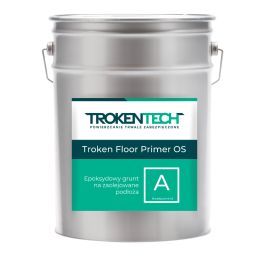
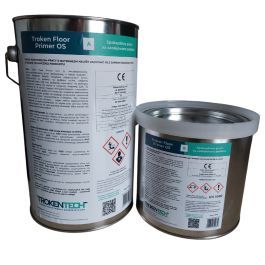
A two-component, solvent-free epoxy primer for dry and oiled concrete substrates. It strengthens the substrate, creates a bonding layer, and adheres perfectly to concrete surfaces.
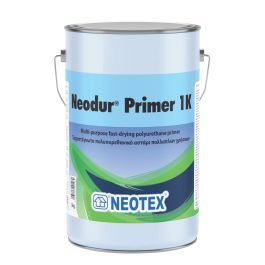
A single-component polyurethane primer designed for surface preparation before applying resin systems. Ideal for asphalt , cement , and metal . Quick-drying and flexible , it provides excellent adhesion and shortens project implementation time.
What are the substrate requirements before applying polyurethane resin?
keyboard_arrow_downkeyboard_arrow_up
The substrate should be dry, stable, free of contamination, and properly primed to ensure optimal resin adhesion. If the substrate is too weak, the resin terrace system may not adhere or may later separate with the substrate. Suitable epoxy-based primers, such as Neopox® Primer WS, are used for this purpose, and can be applied to damp substrates. This increases the adhesion of the topcoat resin to the concrete while allowing application in virtually any humidity conditions. Any gaps or irregularities should be filled and repaired using ready-made repair compounds such as Epoxol® Putty, Epoxol® Liquid, or an epoxy primer mixed with sand, such as Neopox® Primer WS or Epoxol® Primer SF-P.
How to care for a surface covered with polyurethane resin?
keyboard_arrow_downkeyboard_arrow_up
Regular cleaning with a soft brush or mop and avoiding the use of aggressive chemicals will help maintain the aesthetics and durability of the coating.
How much does polyurethane resin application cost?
keyboard_arrow_downkeyboard_arrow_up
The cost depends on the product selected, the size of the surface, and labor costs. On average, the price per square meter ranges from 100 to several hundred zlotys, depending on the complexity, the number of gaps to be filled, the square footage, and many other factors.
Polyurethane or epoxy resin for the terrace?
keyboard_arrow_downkeyboard_arrow_up
Polyurethane resin is more flexible and UV-resistant, making it a better choice for sun-exposed decks. Epoxy resin may be more suitable for interior applications, but is often used as a primer for decks.





 Anti-corrosion
 Fireproof
 Resin floors
 Roofs
Roofs
 Tanks and pools
 Terraces and balconies
 Hygienic paints
 Facades and interiors
 Accessories
 Call:
Call: