




 Anti-corrosion
 Fireproof
 Resin floors
 Roofs
Roofs
 Tanks and pools
 Terraces and balconies
 Hygienic paints
 Facades and interiors
 Accessories
 Call:
Call:
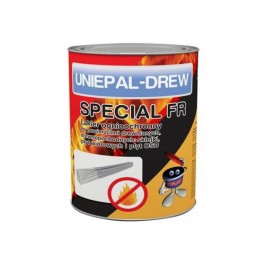
Varnish for fire-retardant and decorative surface protection.
From 873.30 PLN

Protecting steel structures with fire-retardant paints has become a standard in construction. These paints are also called intumescent paints because the coating expands up to 50-fold during a fire. By producing a protective foam, they delay the heating of components, thus delaying the steel's critical temperature. This effectively protects the steel structure and gives people time to evacuate.
Call us - we will help you choose fire retardant paints: +48 717 026 346
To learn more about selecting a fire protection system and to browse products, go to the “ Steel structures ” subcategory.
All of our fire-retardant paints have current ITB or ETA approvals and other documents required for use in construction. We assist in selecting a fire-retardant system and perform calculations for the client. We provide training and a Contractor Certificate.
Fire-retardant varnishes from the Uniepal-Drew line are used to fire-retardantly protect wooden surfaces, giving them an aesthetically pleasing finish. Of course, their properties are crucial, as they allow wood to achieve the appropriate fire classification – Euroclass. According to the Polish standard PN-EN 13501-1, there are seven basic classes for construction products, designated by the letters: A1, A2, B, C, D, E, and F, with flooring designated A1fl, A2fl, Bfl, Cfl, Dfl, Efl, and Ffl. As you might guess, A denotes the best class, and F denotes the worst. Additionally, two supplementary classes are designated: s and d. The symbol s (for smoke) indicates the amount of smoke a material produces during a fire, while the symbol d (for droplets) indicates the formation of flaming droplets that can contribute to the spread of fire. Combining these symbols creates a Euroclass, e.g., B-s1,d0. To learn more about the meaning of these symbols and browse products, go to the " Wood " subcategory.
Uniepal-Drew Special FR - solvent-based fire-retardant varnish, for interior and exterior use
Uniepal-Drew Aqua Kolor - water-based fire-retardant varnish, for interior use, recommended for protecting roof trusses, among others
Uniepal-Drew Aqua 1-K - water-based fire-retardant varnish, for use on floors, furniture, stairs, handrails and other elements requiring higher mechanical resistance
All the products we offer have current ITB approvals and other documents necessary for use in construction.
For help in selecting fire-resistant coatings, call: +48 717 026 346

Varnish for fire-retardant and decorative surface protection.
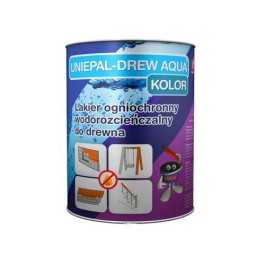
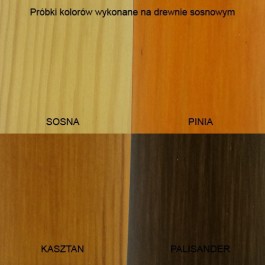
Fire-retardant wood varnish in a variety of colors. For indoor and outdoor use.
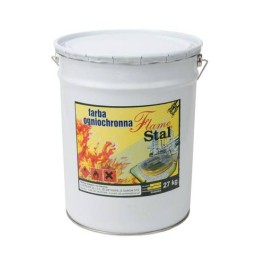
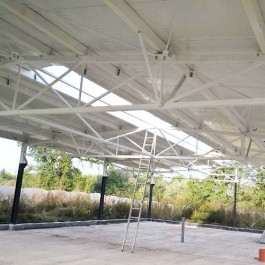
Fire-retardant intumescent paint for both interior and exterior use. Easy to apply and quick-drying.
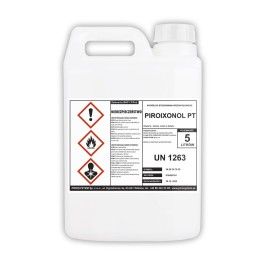
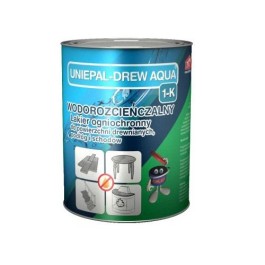
A clear wood varnish for protecting and finishing wooden surfaces. A fire-retardant product with high hardness and resistance.
Each intumescent paint has appropriate documentation, including a European Technical Assessment or ITB Technical Approval. This document provides all information about primers and topcoats that can be used with a given intumescent paint. These coatings are tested and approved by the fire retardant paint manufacturer for use in paint systems. Typically, specific product names and types (e.g., anti-corrosion epoxy primer) are provided, or the standard to which a given paint must be manufactured to be considered a primer for the intumescent paint. the following primers can be used for the C3 corrosivity class of Flame Stal Steelguard 651 , we no longer have such flexibility and must use a primer from specific products listed in the European Technical Assessment. Another example is Nullifire SC803 paint, where we can choose from: - two-component solvent-based epoxy primers - solvent-based alkyd primers - water-based acrylic primers. In summary, fire retardant paint cannot be applied over just any primer. If there is already paint on the structure and we don't know the specific coating, unfortunately, it must be removed. The use of a primer that does not comply with the documentation may result in problems during acceptance or the detachment of the entire paint system during a fire.
There is no clear answer to this question. The coating thickness, and therefore the number of layers, of fire retardant paint depends on three factors. The first is the steel profile cross-sectional mass index. This index varies for different steel profiles; for example, for an IPE240 I-beam, it is 236 [l/m], and for a UPN300 channel section, it is 162 [l/m] (for profiles exposed to fire on all four sides). The second factor is the critical temperature, which should be determined by the designer. The critical temperature can be, for example, 550ºC, but it can also be 650ºC. For each of these values, the coating thickness for the same steel profile will be different. The third factor is the required fire resistance class. The classes are designated R15, R30, R60, and R120. The number indicates the time in minutes – how long the fire retardant coating delays the structure from reaching the critical temperature during a fire. In other words, it can extend the time needed to evacuate people or conduct firefighting operations. The higher the fire resistance class, the greater the thickness of the intumescent paint coating. For example, for the previously mentioned IPE240 I-beam, critical temperature 550ºC, assuming it is a column: - for class R15 - 0.226 mm of dry Nullifire SC803 paint; - for class R60 - 0.684 mm of dry Nullifire SC803 paint
We select fireproof paint depending on the profiles that make up the steel structure and the required class of fire protection. We always choose the paint optimally for a specific case, so as to obtain the thinnest possible coatings and, consequently, a lower price of the material per square meter. Some paints work better on open profiles (e.g. I-beams), while they are unfavorable for closed profiles (e.g. square pipes).
There is no general recommended fire retardant paint coating thickness. The fire retardant paint thickness is selected based on the required protection class (R15, R30, R60, etc.), critical temperature, and the steel profile cross-sectional mass index. Based on this, the intumescent paint coating thickness is selected from the tables in the European Technical Assessment issued for the product.
The recommended method for applying fire retardant paint is airless spraying. Spraying isn't always possible, and sometimes we need to paint several joist legs extending from the ceiling, and in such cases, spraying won't be economical. In such cases, we can apply intumescent paints by hand, but they are quite thick, and when applied by hand (roller or brush), a textured finish will remain (orange peel from the roller, gray from the brush). It's also important to remember that when applying a single coat by brush, a dry film thickness of no more than 150-250 microns will be applied. For higher protection classes, the required dry film thickness can be as high as 1500 or 4000 microns. It's easy to calculate that this means applying, for example, 10 coats by brush, whereas spraying can achieve up to 800 microns in a single coat.
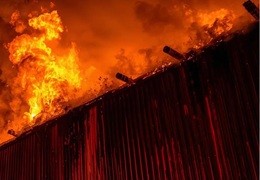


Proven products
We offer products with high durability and technical parameters, ensuring long-lasting results.

Help in choosing
Wondering which products will best suit your needs? Call us – we'll advise you and choose the right solution.

Contractor support
Need help with construction work? Let us know, and we'll recommend trusted contractors.

Stationary points
Want to pick up your products in person? Or perhaps you'd prefer to chat face-to-face? Visit our branches in Warsaw, Wrocław, Katowice, or Gdańsk.

Wholesale orders
Looking for systems and products for investment? Send us your phone number and we'll call you back with an offer including an investment discount.